Skype For Mac Dialpad

Best Mac Antivirus Protection. Skype now lets anyone, even free account holders, to conduct group video chats with up to ten participants. Skype (for Windows): Dialpad To call phones from.
- Skype For Business Dial Pad Missing
- Skype For Business Dial Pad
- No Dial Pad In Skype
- Skype Dial Pad Not Working
- Skype Dial Pad Not Showing
In the Teams client, the dial pad enables users to access Public Switched Telephone Network (PSTN) functionality. The dial pad is available for users with a Phone System license, provided they are configured properly. The following criteria are all required for the dial pad to show:
- User has an enabled Phone System (“MCOEV”) license
- User has Microsoft Calling Plan or is enabled for Direct Routing
- User has Enterprise Voice enabled
- User is homed online and not in Skype for Business on premises
- User has Teams Calling Policy enabled
- Yes it is dialpad in the window for an active call.When we dial a IVR,it will give prompt but to enter the DTMF the dialpad is missing. Skype Profile already deleted. When we are trying to login with the another user sip address it is working fine.
- About Skype for Mac Skype is a little program for making free calls over the internet to anyone else who also has Skype. It's free and easy to download and use, and works with most computers. Now it also supports video conferencing over the net.
The following sections describe how to use PowerShell to check the criteria. In most cases, you need to look at various properties in the output of the Get-CsOnlineUser cmdlet. Examples assume $user is either the UPN or sip address of the user.
User has an enabled Phone System (“MCOEV”) license
You must ensure that the assigned plan for the user shows the CapabilityStatus attribute set to Enabled and the Capability Plan set to MCOEV (Phone System license). You might see MCOEV, MCOEV1, and so on. All are acceptable--as long as the Capability Plan starts with MCOEV.
To check that the attributes are set correctly, use the following command:
The output will look like the following. You only need to check the CapabilityStatus and the Capability Plan attributes:
User has Microsoft Calling Plan OR is enabled for Direct Routing
If the user has Microsoft Calling Plan, you must ensure that the CapabilityStatus attribute is set to Enabled, and that the Capability Plan is set to MCOPSTN. You might see MCOPSTN1, MCOPSTN2, and so on. All are acceptable--as long as the Capability Plan starts with MCOPSTN.
To check the attributes, use the following command:
The output will look like the following. You only need to check the CapabilityStatus and the Capability Plan attributes:
If the user is enabled for Direct Routing, the user must be assigned a non-null value for OnlineVoiceRoutingPolicy. To check the attribute, use the following command:
The output should have a non-null value, for example:
User has Enterprise Voice enabled
To check if the user has Enterprise Voice enabled, use the following command:
The output should look like:
User is homed online and not in Skype for Business on premises
To ensure the user is homed online and not in Skype for Business on premises, the RegistrarPool must not be null and the HostingProvider must contain a value that starts with “sipfed.online.” To check the values, use the following command:
The output should be similar to:
Skype For Business Dial Pad Missing
User has Teams Calling Policy enabled
The user’s effective TeamsCallingPolicy must have AllowPrivateCalling set to true. By default, users inherit the global policy, which has AllowPrivateCallingPolicy set to true by default.
To get the TeamsCallingPolicy for a user and to check that AllowPrivateCalling is set to true, use the following command:
The output should look like:
Additional notes
Skype For Business Dial Pad
You may need to restart the Teams client after making any of these configuration changes.
If you recently updated any of the above criteria, you may need to wait a few hours for the client to receive the new settings.
If you still don’t see the dial pad, check if there is a provisioning error by using the following command:
- If it has been more than 24 hours and you are still seeing problems, contact Support.
Skype for Business has been available in the faculty for a number of years. If you do not have Skype for Business on your computer, refer to Using Skype for Business in AHS for instructions on how to download, install and login.
With the move to Skype for Business telephone lines, faculty and staff need to become familiar with using software to make and receive telephone calls. The use of computer speakers, microphone and software for telephone service is often referred to as a softphone.
How to set up your devices
To set up your devices in Skype for Business, Select Preferences from the Skype for Business menu bar and select the Audio/Video option. On the resulting settings menu, you can choose which device(s) you want to use for your microphone, speakers and Camera.
Note that you can also set the ringer (Ringing) to go to a different device than you use for calls (e.g. computer speakers rather than headset)
Making a test call
Before making the first call of the day, it's a good practice to do a test call to make sure everything is working as expected. You can do this before any important call by calling the Audio Test Service account.
Select the Contacts option in Skype for Business and search for the 'Audio Test Service' contact in the search area
Call the Audio Test Service by selecting the contact entry and selecting the 'Call - Skype Call' option on the contact card displayed (see below)
Change your voicemail greeting
To change your voicemail in Skype for Business, select Preferences from the application menu bar and then click on the Change Voicemail Greeting button (see below).
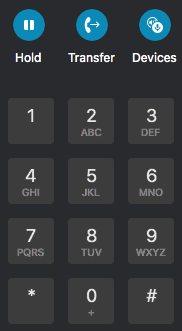
This will call your voicemail account and you can then navigate the menus using the call controls to change/record your greetings. To access the call controls (dialpad) while on a call, move your mouse into the call window and click on the Call Controls icon (telephone) at the top-right of the call window (see below).

Retrieving voicemail
There are multiple ways for you to get messages left on your voicemail:
- An audio file will be sent (as an attachment) to your email account along with a transcription of the message where possible. NOTE: if you delete this email message, it will also delete the voicemail message.
- The voicemail recording will appear in the list of voicemails under the 'Calls' option in Skype for Business. To play the audio file on your computer, select the voicemail messages in the list and a small audio play control will appear below the number. Click the play icon (see below).
Calling somone else at UW
To call someone who works at the University of Waterloo, start typing their name in the search window of the contacts and a list of entries will be retrieved from the directory.
To call the person, select their entry in the list of contacts and click on the phone icon in the contact card displayed to the right. Select the 'Skype Call' option when prompted (see below).
If you know the extension, you can always use the dialpad on the 'Calls' option to enter the 5 digit extension either by using the onscreen buttons or enter the extension number in the area above the dialpad using your keyboard (see example below dialing extension 40000).
No Dial Pad In Skype
Calling an external number
Use the 'Calls' option to dial external phone numbers just like on-campus extensions - using either the dialpad or enter the number in the area above the dialpad using your keyboard.
- To call a local external number, enter the 10 digit number - the area code and 7-digit number. You do not need to preface the number with a 6 as with older on-campus phones. (AreaCode-Number)
- For long distance or toll-free numbers, preface the 10 digit number with a 1 (1-AreaCode-Number)
- For international long distance calls, enter 011 followed by the country code and the number (011-CountryCode-Phone Number).
Note that your phone line must be enabled for international long distance. Contact your unit telephone administrator for details.
Inviting additional people to your current call
Once you are in a call, it is possible to add or conference in other people to the call. While in the call, move your mouse over the call window and click on the 'Invite More People' button in the upper-right corner of the call window (see below)
Skype Dial Pad Not Working
You can invite people by name (using the directory/contacts) or telephone number in the input area provide above the Attendees list (see above). Enter the name or number of the person that you want to add and double-click on the entry to add them to the call.

Using contact groups (and making a conference call)
Skype Dial Pad Not Showing
There is a default contact group called 'Favorites' that you use have your frequently contacted people readily available. You can also create your own groups to organize your contacts. If you have a group of people that you call as a group frequently, you can create a contact group that group and then call them all with one click as opposed to adding them individually to an existing call.
To add a contact to your favourites group, search for them in the directory or find them in your call history and Ctrl-click on their entry and choose 'Groups' and then 'Favorites' (see below)

To create a new contact group, select a Group in the contacts list (Favorites will do) and then select 'New Group' from the Contacts option in the menu bar (see below).
A new group will be added to the bottom of your Contacts list and you can provide a name for the new group. To delete or rename the group, Ctrl-click on the group name. The groups are listed alphabetically (you cannot change the order but can name groups with an underscore '_' character to move them to the top of the list.
Adding members to a group is the same process to add a person to the Favorites group but you select the group name from the Groups option as opposed to choosing 'Favorites'.
To call a contact group (i.e. a conference call), select the group name in the contacts list and click on the call button (telephone icon) in the contact page that appears to the right (see below).